Finishing Books With Two Kids and a Full Workday (What It Actually Costs)
October 1, 2026
I used to tell myself I’d get back to reading properly once things calmed down.
Cole’s nine now. Luke’s seven. I’ve got a crew to keep busy and a job site that always wants something from me by 7am. Nothing calmed down. Nothing is going to.
What I didn’t see coming is that I now finish more books than I did during the two years I spent waiting for things to calm down, and the honest explanation isn’t a clever trick for hiding twelve minutes inside a Tuesday. It’s a list of things I used to do and don’t do anymore. Reading didn’t get added to my week. Something else came out to make room for it, and that’s the part these articles always leave out.
The free hour is not coming back
For about two years I was waiting on an hour.
Not on purpose. But that’s exactly what I was doing — keeping the whole habit parked in a waiting room until my life produced one clean, quiet, uninterrupted hour I could do it in. Cole was small. Then Luke was small. The hour never showed up, because of course it didn’t. I was standing by the door waiting on a delivery nobody had ordered.
The mechanics of getting unstuck from that I’ve already written down — set your nightly page floor low enough to embarrass you, then pick one slot and defend it — and I’m not going to run the same lap here. That post is the how. This one’s the bill.
Because once you quit waiting on the hour and start counting what you’ve actually got, you learn something a bit uncomfortable: reading isn’t a thing you add to a full week. It’s a thing you trade for.
Count the week instead of guessing at it
On a house I don’t guess at the lumber. I do a takeoff — count the studs, the sheets, the joists, every last one, before a truck ever leaves the yard. Nobody frames a wall on a feeling.
Meanwhile I’d been running my own week entirely on a feeling, and the feeling said you don’t have time to read, and the feeling was flat-out wrong. So one week I counted. Here’s what’s actually in there, in a normal week with nothing unusual going on:
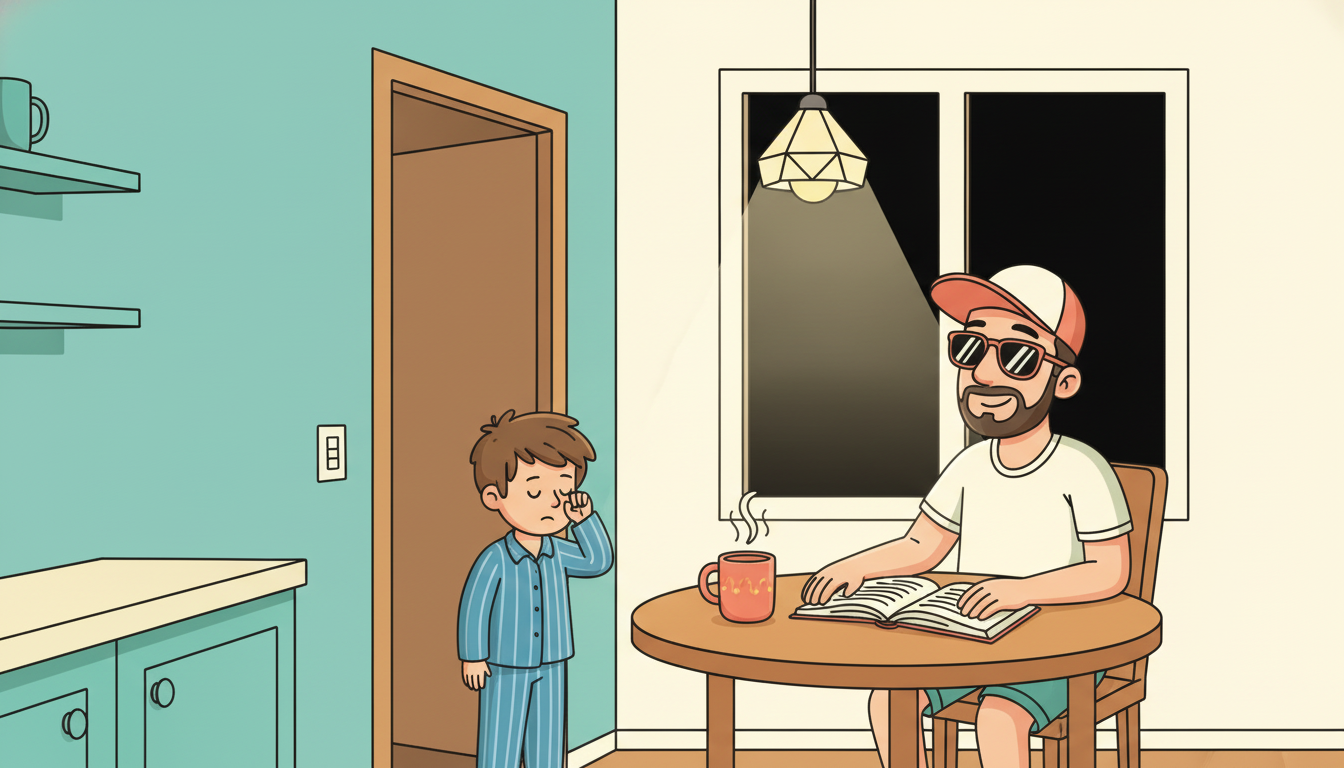
- Twenty minutes at the kitchen table before anybody’s up. Dark out, coffee on, nobody needs a thing from me yet. This is the best one and it isn’t close.
- Lunch in the truck. Twenty-five minutes, three or four days a week, radio off, boots still on. Not glamorous. Very steady.
- After the boys are down. Anywhere from fifteen minutes to the bad kind of forty where I look up and it’s past midnight and I have to be on a site in six hours.
- The drive. Forty minutes each way to most of my sites. That’s about five hours a week on audio and yes, I’ve ruled on whether that counts.
Add it up and a normal week has four to six hours of reading in it.
That’s not nothing. It’s also nowhere close to the guy I had in my head — the one with a whole Sunday afternoon and a hammock. That guy is fictional. He has never once existed in this house, and I spent years feeling like a failure for not being him.
Four to six hours in pieces is two books in a month if the books cooperate. It’s one book if they don’t. And about half the time, they don’t.
A chopped-up week can’t carry every book
Here’s the thing I wish somebody had told me sooner. Twelve minutes is plenty of time to read a book. It’s not much time to hold one.
Pick up something with forty names in it, three timelines, a family tree in the front and a map behind that — then try reading it in twelve-minute slices across five weeks. Every single session opens with a toll. Who’s this guy. Where are we. Why is she angry at the brother, and wasn’t he dead. You pay it, you get maybe eight real minutes of story, you put it down. The toll creeps up. And one night you quietly stop paying it, and the book sits on the nightstand for three weeks while you tell anybody who asks that it’s a slow burn.
That’s not a bad book and it isn’t a bad reader. It’s the wrong book for the shape of your week.
So I match them up now, which has done more for my finished-book count than any amount of extra discipline ever did. A fragmented week gets a book built to survive being put down mid-sentence — short chapters, and a hook that grabs you again every time you come back to it. The five thrillers I keep recommending for a loud pool deck all pass that test for the same reason they pass the vacation one: being interrupted doesn’t break them.
The dense ones still get read. They just go in the suitcase instead of the lunch bag, and they wait for the trip, when I’ll have a quiet balcony and a real run at them.
And when I lose the thread anyway — which happens most when a series straddles a busy month — there’s a two-minute note I write that saves me a reread. That trick has rescued more books for me than willpower has.
Reading with them in the room is a different job than reading after they’re down
These two get talked about like one activity. They are not remotely the same thing, and pretending otherwise is why people feel like they’re failing.
After nine, both boys asleep, house quiet — that’s reading. The real kind. Pages actually go by.
Earlier in the evening, me on the couch with a paperback while Luke does something structural to the Lego and Cole half-watches a show? Let’s be honest about what that is. That’s being available, with a book open. I’ll get four pages in forty minutes and two of them twice, because Luke has a question about crocodiles roughly every ninety seconds and he does not consider a bookmark to be a legal argument.
I do it anyway. The page count is not the reason.
Cole reads on his own now. Nobody nagged him into it — he was a kid who’d play Minecraft until his eyes dried out, and the thing that finally turned him was a book built like the games he already loved. But I don’t think that book would have worked on him if he hadn’t also spent a couple of years watching his dad do it in the same room, on an ordinary Tuesday, with no lecture attached. Kids don’t take up reading because you explained its benefits. They take it up because it looked like something a person in their house does.
So I count the couch time as a different line item entirely. Terrible for finishing books. Possibly the most useful twenty minutes in the week.
What it cost
This is the part I owe you, since everything above is just arithmetic.
Four things came out of my evenings:
- The second episode. Dee and I still watch the one. The second one is where my reading used to go, every night, automatically, and I don’t miss it as much as I expected to.
- My phone. This was the hard one. I was giving that thing most of an hour a night in ninety-second pieces and I’d have sworn under oath it was ten minutes. The charger lives across the room now, which makes picking it up a decision instead of a reflex.
- Highlights and box scores at eleven at night. I still follow the hockey. I just quit re-watching a game I’d already seen the result of.
- The fictional Sunday afternoon. Giving up the idea of it freed up more than any of the others. You can’t imagine how much energy I was spending on an hour that was never coming.
Two things are not on the table, and I want to be straight about them because they’re the reason my number isn’t higher.
I don’t skip the rink. Cole’s practices land at hours a reasonable adult would call hostile, and I’m not going to sit in that lobby with my nose in a paperback while he’s looking for me through the glass — I did that twice and felt like a jerk both times. And the stretch after the boys go down belongs to Dee. I read after that, not instead of it. She’s noticed the nightstand stack has gone load-bearing and she’s never once suggested I move it, which is its own kind of generosity.
So what does the year actually look like
Fewer books than I managed at twenty-five. Quite a few fewer.
I’d make the same trade again tomorrow, and I’d make it without thinking very hard about it. But I’m not going to dress that up as a win, because the honest version is more useful to you than the inspirational one: the number went down, the number is fine, and the number is still a good deal bigger than it was when I was waiting around for a free hour and reading nothing at all.
That’s the whole system, really. No free hour. Four to six hours a week in pieces. A book picked to survive getting put down in the middle of a sentence. And a shorter list of evening habits than I had five years ago.
It’s 5:40 in the morning as I’m finishing this. Kitchen’s dark, coffee’s good, and in about twenty minutes a seven-year-old is going to come around that corner and ask me what I’m reading.
Which is a perfectly fine way to lose the end of a chapter.