How to Read More When You're Wiped After Work
September 10, 2026
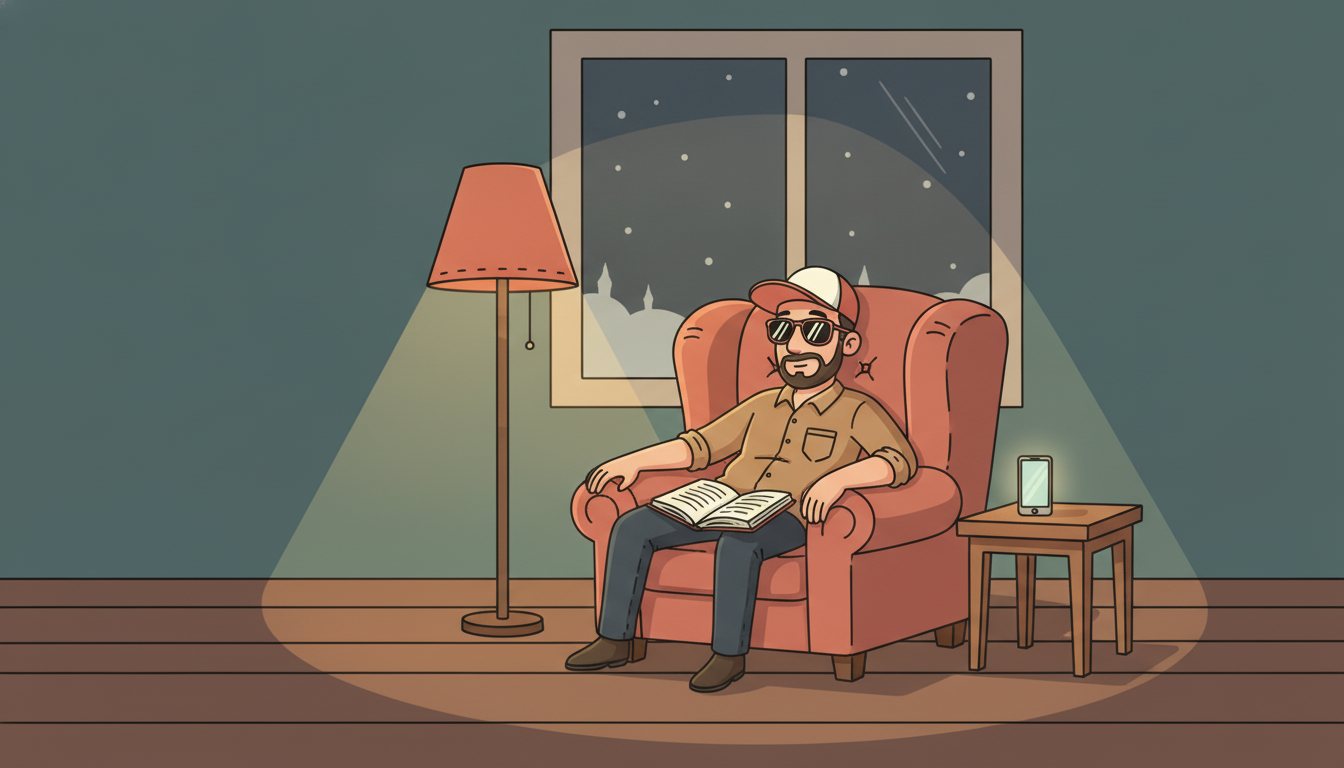
Nobody quits reading on purpose.
For about two years I told people I used to read a lot. Past tense. Like a knee I’d blown out.
I still bought books. There was a stack on my nightstand tall enough to be a code violation, and I’d look at it every single night on my way to falling asleep with my phone on my chest.
I wasn’t lazy about it. I frame houses for a living — nobody who does that is short on discipline at 6:30 in the morning. But there’s a version of me that shows up at 6:40 at night, and that guy has about as much willpower as a wet paper bag.
Took me way too long to work out that the problem wasn’t me. It was the size of the thing I kept asking myself to do.
Willpower isn’t what’s broken
Here’s what was actually happening. Around nine o’clock I’d think about reading, and buried inside that one thought was an entire project: find the book, find my page, remember who all these people are, and then put in a real session. An hour, probably. Something that counts.
Tired brains don’t sign up for projects. Tired brains take whatever has the fewest steps in it, and my phone was sitting right there with no steps in it at all. So I lost. Every night. To a rectangle.
Not because I like scrolling more than reading — I like reading a whole lot more, it isn’t close. I just never got as far as the reading part, because the front door was too far from the couch.
That’s really the whole diagnosis. Everything below here is just moving the door closer.
Shrink the goal until it’s embarrassing
Ten pages.
That’s a floor, not a target. Ten pages and I’m allowed to shut the book, go to bed, and feel fine about it.
Ten pages takes me about twelve minutes. I can find twelve minutes on the worst day I have ever had. And here’s the slightly dumb secret at the middle of this: I almost never stop at ten. Some nights I do, and those nights still count — that’s the entire point of a floor. But most nights the book gets its hooks in somewhere around page three, and then you look up and it’s been forty minutes and you get that nice “oh no, it’s late” feeling that means the thing worked.
Ten pages a night, every night, is about 3,600 pages a year. Call it ten or eleven books. Out of the guy who doesn’t have time to read.
So pick a number you can hit when you’re wrecked. If ten’s too many, make it five. If five’s too many, make it one — I’m not being cute, one page counts, and one page beats the version of tonight where the book never opens.
One rule, and it’s the one people break: don’t raise the floor because you had a good week. The floor isn’t for the good weeks.
Pick one slot and defend it
The advice you usually get is to read whenever you find a pocket of time. Sounds reasonable. Does nothing. The pockets never announce themselves, and if you’re waiting to find time you’ll be waiting a while.
One slot instead. Same time every day, and only that one.
Mine’s early. I’m up before the house is — job sites start early and the alarm clock got its hooks in me a long time ago — so I pour a coffee and take twenty minutes at the kitchen table while it’s still dark out. That’s not discipline. That’s scheduling. I picked the one window in my day that nobody else has a claim on, which is the only reason it survives.
Yours might sit at the other end of the day entirely. After the kids go down. On your lunch break, in the truck, with the radio off. Twenty minutes before bed with the phone charging in a different room. Which one you pick genuinely doesn’t matter. What matters is that it’s the same one, every day, so you stop having to decide.
The deciding is the expensive part. Once it’s just what happens at that hour, it stops costing you anything at all.
Make the book easier to reach than the phone
This one is a little embarrassing and it works better than everything else on this page.
The book has to be closer. Physically closer. Same room, same chair, face up, bookmark in it.
I keep one on the arm of my chair and one on the nightstand, and my phone charger lives across the room now, so grabbing it is a decision instead of a reflex. My wife Dee says the stack by my side of the bed has gone load-bearing. She’s not entirely wrong — I’ve caught myself setting a coffee on it.
Couple of small ones in the same family:
- Leave the book open, or face-down on your page. Zero steps to restart.
- Keep one in the truck. Waiting rooms, the ten minutes before an appointment, lunch on the tailgate — that’s real reading time and it costs you nothing.
- If a book’s been sitting untouched for two weeks, the habit didn’t break. The book did. Swap it out and keep the streak going.
That last one carries more weight than people want it to. When you’re rebuilding this, read the trashiest, fastest, most ridiculous thing you can get your hands on. Not the important novel you feel like you’re supposed to be reading. Right now the habit is the whole job, and nothing rebuilds a habit like a book that drags you along behind it. You can go be a serious person again in March.
Let audio cover the hours you can’t
I’ve got a forty-minute drive to most of my sites, and for years that was the radio and somebody’s brake lights. Now it’s a book.
That’s five hours a week I never had to find. Same goes for a long repetitive stretch of framing, or shovelling the walk, or the hour every Sunday I spend cleaning the shop and telling myself I’ll keep it that way.
People will want to argue with you about whether that counts as reading. I quit having that argument a while back. The story got in and stayed in. That’s the transaction.
Audio’s also got one specific superpower for this exact problem: it works when you’re too far gone to read. Some nights my eyes are finished by 8:30 but my head still wants to be somewhere else, and lying in the dark with a narrator going is the only version of reading left on the menu. It catches you on the nights your floor is still too high.
One warning, learned the hard way. Audio is rough on anything stuffed with names, maps, and numbers. I put a big fantasy doorstopper on in the truck one spring and spent three weeks with no clear idea who anyone was or why they were mad at each other. Keep the complicated ones on paper. Give audio the books that are mostly people talking and things happening.
What to do this week
Three changes, and they take about four minutes.
Set your floor low enough to embarrass you. Pick the slot you already know is yours — you thought of it two sections ago. Then physically move the book closer than the phone, tonight. Not as an idea. Get up and move both.
Then read ten pages of something you’d be a bit sheepish about.
I got back nearly all of what I figured a trade and two kids had taken off me, and the funny part is I hadn’t actually lost the time. I’d been standing there every night asking for a full hour, from a guy who plainly didn’t have one, when twelve minutes would’ve done the job just fine.