How to Get a Gamer Kid to Read: Hand Him a Book Built Like a Game
September 15, 2026
I used to think Cole didn’t like reading.
He’s nine. He’ll play Minecraft until his eyes go dry and Dee has to physically stand between him and the TV. Hand him a chapter book and he’s out in about four minutes — not fighting it, just gone, eyes drifting to the window like the thing is emitting a gas.
So I did what everybody does. Limits on the console. Twenty minutes of reading before screen time. A very reasonable speech about how books are better for your brain, delivered by a guy who was in that moment scrolling his phone.
None of it worked, and it shouldn’t have, because I’d got the problem backwards. Cole isn’t against reading. He’s against this, the specific book I keep handing him, which asks for forty minutes of patience up front and promises a payoff somewhere around chapter six.
The game never asks him for that. It gives him something in the first ninety seconds.
What a game is actually doing to your kid
Strip a video game down and it runs on a short, honest loop. Do a thing, get a number. The number goes up. A new thing opens because that number went up.
That’s it. That’s the engine. Levels, loot, a skill tree, a bar filling up in the corner — different paint on the same machine. It works on adults too, which is why I’ve lost evenings to it myself.
Now here’s the part I didn’t know until about two years ago. There’s a whole genre of books built on exactly that machine. It’s called litRPG — short for literary role-playing game — and in a litRPG the character genuinely levels up, on the page, with the stats shown to you. Progression fantasy is the slightly looser cousin: no visible stat sheet, but a character who starts weak and climbs a clear ladder you can feel him climbing.
The books are shaped like the loop. A kid who’s been trained by games to expect a number every couple of minutes opens one of these and the format doesn’t feel foreign. It feels like home with better writing.
That’s the whole trick. You’re not making him quit the thing he loves and take up something unrelated. You’re handing him the same loop in a different box.
The honest part, before you go buy anything
Most litRPG is not for your kid.
I want to be blunt about this because there’s a version of this advice floating around that isn’t, and some dad is going to hand a fourth-grader something rough. The genre grew up on self-published adult fiction. A lot of it swears constantly. A lot of it is violent in a way that isn’t cartoon violence. Some of it is worse than that.
The book I personally push hardest on adults is Dungeon Crawler Carl, and I would not let Cole within a country mile of it for years yet. It’s brilliant. It’s also a guy in his underwear fighting his way down through a collapsing planet with a talking cat, and the language alone would get me a phone call from school.
So the shelf below isn’t “here’s litRPG.” It’s a ramp. The bottom of it is genuinely written for a nine-year-old, and it gets steeper from there.
Start here: a book the size of a good afternoon
Trapped in a Video Game by Dustin Brady is where I’d start almost any kid between about eight and twelve.
Premise: a kid gets sucked inside the game he’s playing and has to finish it from the inside to get out. That’s not a metaphor and the book does not make you wait for it. It happens early and then it just goes.
What makes it work isn’t the plot, though. It’s the build. Chapters are three or four pages. Almost every one ends on something breaking, appearing, or chasing him. If your kid has never once finished a chapter book under his own power, this is the shape of book that lets him, because it never asks for more attention than he currently has. It gives him a win, then another one, then another one.
Which, yes, is the same loop as the game. On purpose.
Cole read the first one in two sittings and then asked — out loud, unprompted, like a normal request for a snack — whether there were more. There are. That was the first time it had ever gone that direction in our house.
The one you’d actually read too
Here’s the bit nobody tells you: the first book has to be one you’d read, or this whole plan quietly dies.
Because you’re going to be reading some of it. Out loud, or alongside him, or at minimum well enough to ask a real question about it at supper. And if the book is garbage, you will not do that. You’ll skim it, your questions will be fake, your kid will clock it instantly the way kids always do, and the book becomes another chore with your name on it.
So: Minecraft: The Island, by Max Brooks.
I know how that sounds. An official tie-in novel for a game about punching trees. I went in ready to be embarrassed for everybody involved. But Brooks wrote World War Z, and what he’s actually done here is take one person, drop them on an island with nothing, and write down how a mind works out survival from first principles. Food. Shelter. Night is dangerous and you have about ten minutes. It’s a real book that happens to be set in blocks.
For Luke, who’s seven and mostly in it for the company, this is the read-aloud. For Cole it’s the one where he gets to be the expert, because he knows the game better than I do and he will correct me, at length, with enormous satisfaction.
For the kid who takes one look at a page and closes it
Some kids aren’t stuck on story. They’re stuck on the look of the page — solid grey text, edge to edge, no air in it. That’s a wall, and they bounce.
The Last Kids on Earth is built for exactly that reader. It’s illustrated all the way through by Douglas Holgate, so there’s always something to land on. And the main character, Jack, does something I think is quietly clever: he treats the monster apocalypse like a game he’s finally good at. He names the monsters. He keeps a list of objectives. He upgrades his gear and he’s thrilled about it.
A kid who games reads that and recognises himself immediately. It’s not a book about a boy who learns to stop playing games. It’s a book where thinking like a gamer is the reason he survives, which is a much more flattering mirror to hand a nine-year-old.
Where it goes next
If your kid is more like thirteen, you can skip most of the ramp and go to Ready Player One.
Virtual world, worldwide treasure hunt, whoever solves it inherits everything. There’s swearing in it and some adult content, so it’s a read-it-yourself-first situation if you’re unsure. For a teenager who games, though, it does a specific job — it’s the first time a lot of them see a proper grown-up novel that takes their whole world seriously instead of treating it as the thing they should be doing less of.
And then years later, when he’s old enough, there’s the far end of the road. Dungeon Crawler Carl and the rest of the adult shelf. That’s not a plan for this year. It’s just useful to know the road keeps going, because one of the quiet worries in all this is that you’re setting your kid up on baby books with nowhere to graduate to. You aren’t. This genre has a very tall ceiling.
What actually worked at my house
The books matter less than the handoff. Here’s what I do now.
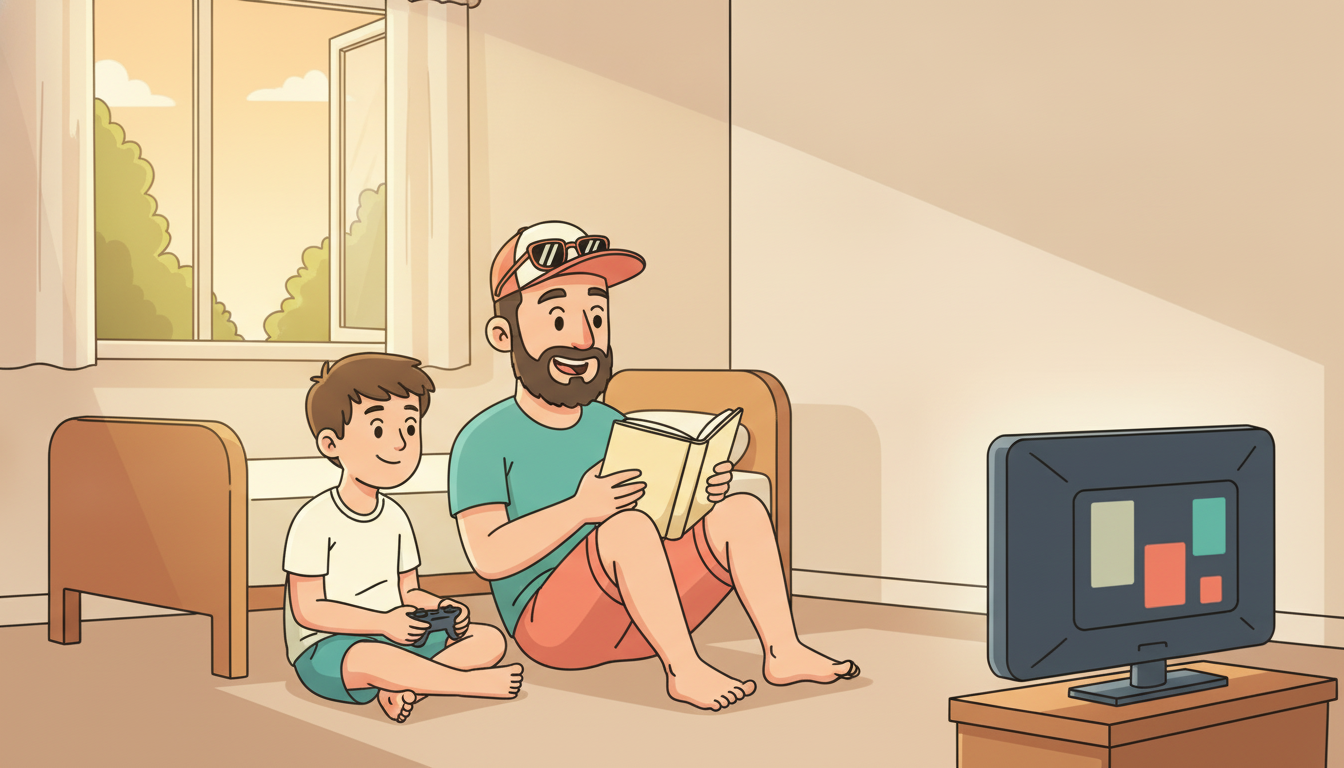
I read the first chapter out loud. Not as a lesson — I just start reading it near him while he’s doing something else, on the floor with my back against his bed, and I stop at the bad moment. Then I put it down and go do something in the kitchen. Nine times out of ten the book comes with him.
I don’t make it the price of screen time. The second a book is a toll you pay to get to the fun thing, it is the toll. It’s not the fun thing. That was my mistake for about a year and it cost me.
And I let him talk about it like a game. Cole will tell me what he’d have done differently, what the character should have built, why the ending of chapter nine was unfair. That’s not a distraction from reading. That’s a kid who is inside a story, which was the whole point.
When he quits book one
He’ll quit one. Probably soon.
Don’t fix it with a conversation. Fix it with a different book, and don’t mention the first one again — a kid who bounced off page thirty and then got a lecture about finishing what you start has learned that reading comes with a lecture attached. You’ve now made it worse than it was.
The book was wrong. That’s all it ever means at this age. Wrong reading level, wrong day, wrong week. Grab another one off the ramp, leave it somewhere he’ll find it, and go do the dishes.
I’m a carpenter. If a board splits on me I don’t hold a meeting about the board. I get another board.
So, the short version. Stop trying to win an argument against the console, because the console isn’t arguing — it’s just better at giving a nine-year-old a reason to keep going than most chapter books are. Find books that are honest about running on the same engine. Start him lower than you think, read the first chapter out loud, and when a book fails, quietly replace it.
Cole finished four books this summer. The prairie winter’s coming, which around here means five months of indoor time, and for the first time I’m not dreading what he does with it.