When Should You Stop Reading to Your Kids? Not at Seven
October 15, 2026
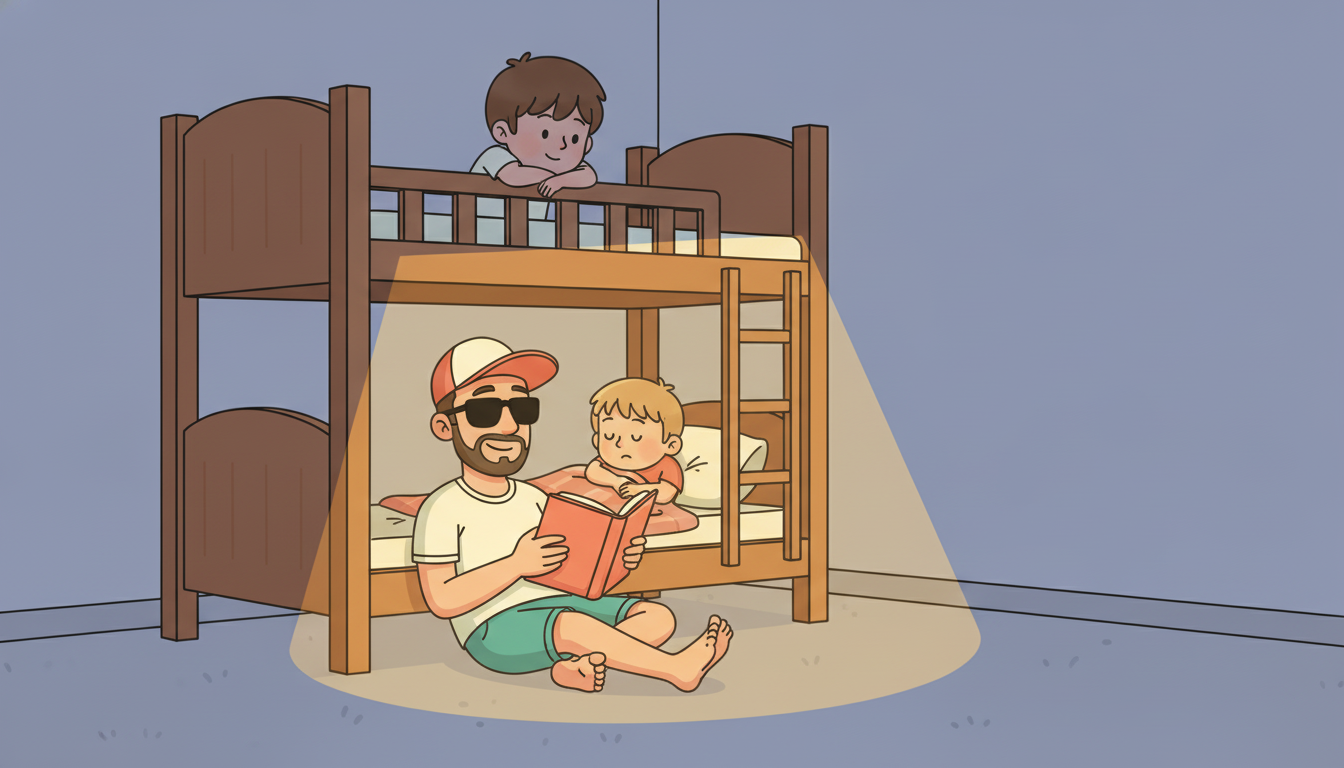
Cole caught me stalling.
He’s nine. He reads fine on his own now — chapter books under the covers with a flashlight, like he invented the idea. And a few weeks back he looked up in the middle of a chapter and asked why I was still doing this.
He wasn’t being a smart aleck about it. He was just curious, the way he gets about anything that doesn’t have an obvious reason. He can read the book himself. I know he can read the book himself. So what exactly am I doing on his bedroom floor at eight o’clock on a work night, with my back against the bed frame and my voice going?
I gave him a lousy answer. Something about how I like it. Which is true, and which holds up about as well as a shelf hung on drywall anchors when a nine-year-old leans on it.
Here’s the answer I should have given him.
The year it dies, and the reason is the wrong one
Scholastic runs a long-running survey of families and reading called the Kids & Family Reading Report. One edition is literally titled The Rise of Read-Aloud, and buried in the good news is the part that got me.
Reading aloud peaks at age five.
Their number: about 55% of families read aloud five to seven days a week before their kid starts kindergarten. After that it slides, every single year. The first real drop lands on the six-to-eight crowd — and when the researchers asked parents why it slowed down or stopped, the most common answer was that their child can read on his own.
Read that again, because it’s the whole problem. The most common reason families stop is the exact thing that makes it worth continuing.
I don’t say that to make anybody feel bad. It’s a completely sensible mistake. The whole point of all those picture books was to get him reading, he’s reading, job’s done, go sit down. That’s not neglect. That’s a parent reading a finish line that isn’t there.
His ears are years ahead of his eyes
Here’s the part nobody mentioned to me.
Kids understand a lot more language than they can decode off a page, and the gap lasts way longer than you’d guess. There’s a well-known research review by Sticht and James, back in 1984, that pulled together the work comparing listening against reading. The finding: children’s listening comprehension outpaces their reading comprehension until somewhere in the middle-school years — grades six through eight.
Grades six through eight. Not grade one.
The mechanism isn’t complicated. When Cole reads to himself, a big chunk of his brain is busy running the words. Sounding out the hard ones, keeping the sentence together, remembering how it started, getting from the left side of the line to the right. That’s real work, and it’s work that comes out of the same budget he needs for the actual story. When I’m the one reading, I’m doing that part for him. All his attention goes to what’s happening and why — the plot, and the thing a character said two pages ago that didn’t quite add up.
So reading to a kid who can already read isn’t babying him. It’s handing him a story his eyes can’t reach yet.
I think about it like framing. You don’t pull the temporary bracing off a wall the day you nail the last stud up. You leave it until the permanent structure carries the load on its own. His reading is the permanent structure and it’s coming along fine. The read-aloud is the bracing, and the day he can decode a sentence is nowhere near the day he should lose it.
And the same survey found something I’d file under “worth the eight o’clock effort”: reading aloud before kindergarten and keeping the habit going both show up as factors in whether kids aged six to eleven turn into frequent readers. Not just starting. Continuing.
Take turns by chapter
This is the one thing that changed everything at our house, and it costs nothing.
We alternate. I read a chapter, he reads a chapter. Out loud, both of us, same book, same night.
What I love about it is that it isn’t a lesson, it’s a deal. He isn’t being quizzed. He’s taking his turn, same as me, and when it’s his turn he gets to do the voices badly and I have to sit there and take it. Then it’s my turn and we’re back in the story. Nobody announced that reading practice was happening. It just did.
It also fixes the thing that actually kills the ritual, which isn’t the kid growing out of it. It’s the parent running out of gas. By eight o’clock on a day where I’ve been on a job site since six-thirty, I have maybe one chapter in me, and on a bad day not even that. If the whole bedtime story depends on Dad being fresh, the bedtime story is going to quietly stop happening sometime in March. Splitting it in half means a tired dad can still show up. Some nights he reads two and I read one and I’m not proud, but the chapter got read.
Dee calls it the shift change, and she’s got us dead to rights.
Pick the book that’s a little too hard
If his ears are ahead of his eyes, then the read-aloud book should be aimed at his ears.
So I deliberately pick something above what he’d manage on his own. Not brutal — a step up. Longer sentences, and a plot with more than one thing going on at a time. If he can read it by himself without much trouble, it’s the wrong book for this, because then I’m just doing a job he’s already able to do.
This is also the honest reason the ritual survives past the age it usually dies. A kid quits a thing when it stops offering him anything. If the book I bring is one he could have handled alone, he’s right to think he’s outgrown us. If the book I bring is one he can’t get to yet, I’m not the guy reading him a baby book. I’m the only way in.
That’s where A Series of Unfortunate Events earned its place at our house — I wrote up whether it holds up as a read-aloud — because the sentences are fancier than my boys would pick up on their own and the humor is dry enough that I laugh too. A book that only the kid enjoys is a chore with my name on it, and I will find a reason to skip a chore.
One practical note: the too-hard book is also the one you should be willing to walk away from. If it’s a slog for both of you three nights running, it’s the wrong book, not a character flaw. I have a rule about when to quit a book and it applies double at bedtime, because at bedtime a bad book doesn’t just waste your evening — it teaches a kid that the ritual is boring.
When one kid’s in and the other isn’t
Luke is seven. He is not where Cole is, and for a while I tried to run one read-aloud that served both of them, which served neither.
The nine-year-old wants plot. He wants to know what happens, he wants it to keep happening, and he will get openly impatient if we stop to explain a word. The seven-year-old is mostly here for the company. He wants to be leaned against somebody. He’d like there to be a picture every so often. He is asleep by the end of chapter two no matter how good chapter two is.
What works is not splitting the ritual in half. It’s letting them want different things out of the same twenty minutes.
Same room, same book, and I stop caring whether Luke is following it. He gets the warm part — the voice, and somebody to lean against. Cole gets the story. When Luke drifts off mid-chapter, that’s not a failure, that’s him getting exactly what he came for. And Luke doesn’t take a turn reading unless he asks to, which he does maybe one night in four, and when he does we all slow way down and nobody sighs. Cole knows the rule. He sighed once. We talked about it.
The other half of this is that Luke gets his own thing, separately, on nights when Cole’s at a friend’s place or reading on his own. Shorter, easier, more pictures, and entirely his. If your two kids are far enough apart, one shared read-aloud is probably a compromise that short-changes both — run the shared one for the warmth and give the younger one his own on the side.
If you’re starting further back than this — a kid who won’t pick up a book at all, not a kid who’s moved past needing you — that’s a different job, and I wrote about getting a kid who’d rather be gaming to read separately. This post is about not losing a ritual you already have.
So when should you actually stop?
When he asks you to, more than once, and means it.
That’s it. Not when he can read. Not when he hits some birthday, and not when it starts feeling a bit odd to be reading out loud to a kid who’s nearly as tall as the dresser. Kids will tell you when a thing has stopped being theirs — they’re blunt about it — and the signal you’re waiting for is him turning it down a few nights running without being tired or sulking about something else.
Cole’s nine. On the research, the window where his ears still beat his eyes runs another two or three years at least. I’m planning to use all of it, and when he’s done he’ll let me know, probably mid-chapter, probably while I’m doing a voice.
For what it’s worth, I asked him that night what he thought. He said it was better when I read it because I did the parts right. Then he asked if we could do two chapters.
We did one. I’d been up since five.