The 50-Page Rule: How I Decide to Quit a Book
September 5, 2026
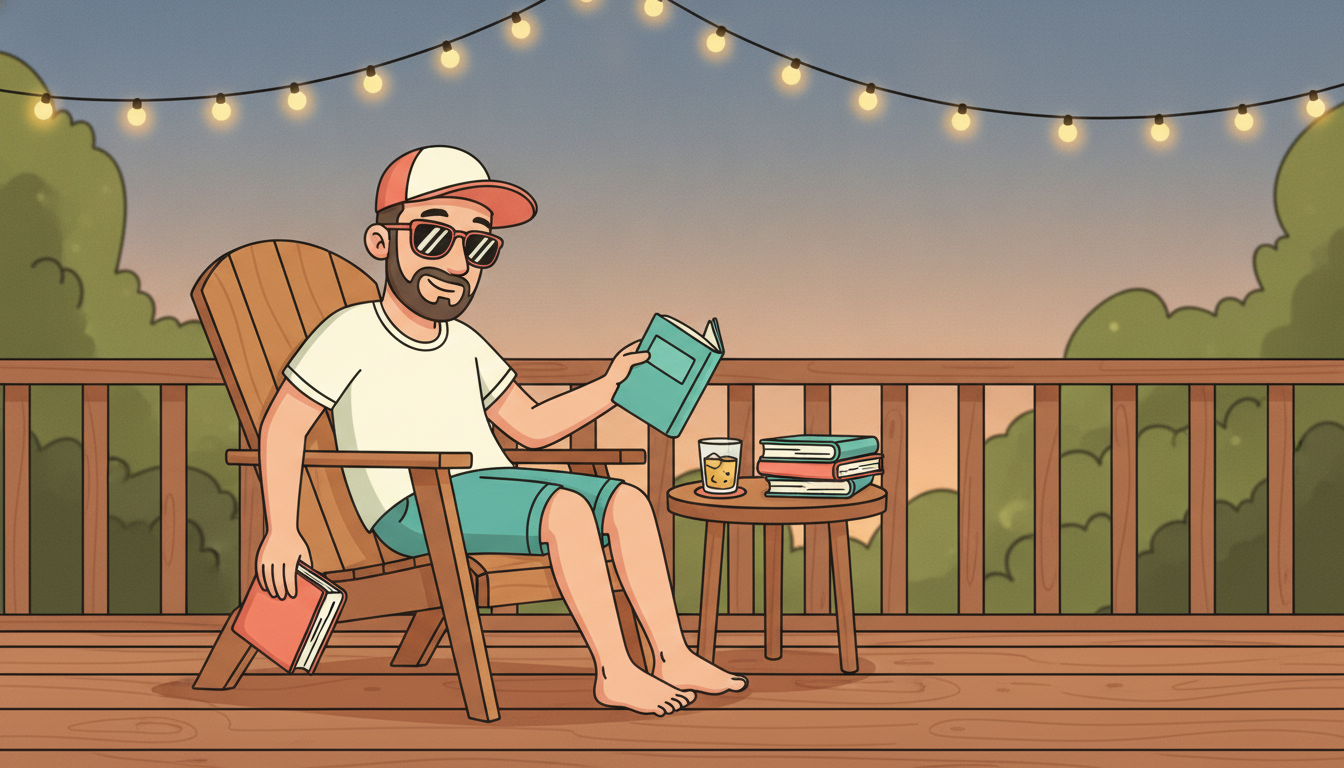
I hauled a book around for six weeks last spring.
Truck, lunch break, nightstand, back to the truck. Every night I’d read four pages, lose the thread, and set it down. And every night I’d tell myself the same thing: it probably picks up.
It did not pick up. I finally admitted that around page 230, which means I spent six weeks of my reading life on a book I already knew I didn’t like by page 40.
Six weeks. For a guy who gets maybe forty minutes a night before his eyes quit on him, that’s a small tragedy.
So I made a rule. I’ll give it to you, and I’ll give you the check that goes with it, because the rule on its own will make you quit good books on bad nights.
Finishing everything is a trap
Somewhere in school we all got taught that starting a book is a promise. Finish your plate. Don’t be a quitter.
Fine for broccoli. Terrible for books.
Here’s the math that changed my head. Say you read a book a month — that’s a solid pace for a working guy with kids. Forty more years of reading? That’s around 480 books. Total. That’s the whole shelf, for the rest of your life. Every book you white-knuckle through is one you took off that shelf and burned on something you weren’t even enjoying.
The money’s already spent either way. The twenty bucks is gone whether you finish or not. What you’re actually deciding is what to do with tonight, and tomorrow night, and the eleven nights after that.
I’m a carpenter. If I’m forty minutes into a cut and I can see the board is wrong, I don’t finish the cut out of respect for the board. I grab another board.
The rule: fifty pages
Fifty pages, then I decide. Stay or go.
I didn’t invent this. It comes from a librarian named Nancy Pearl, who put it in her book Book Lust, and she added a twist I love: once you’re over fifty years old, subtract your age from 100 and that’s how many pages you owe a book. Sixty years old? Forty pages. Eighty? Twenty. The older you get, the less patience you owe anybody. She’s earned the right to say that and I’m just repeating it.
Fifty pages is enough to be fair. You’ve met the main character, you’ve seen how the author writes a sentence, you know whether anything is actually happening. It’s not enough for the “it gets good in book two” crowd, and that’s on purpose. A book has to be worth reading while you’re reading it.
For audiobooks I use time instead of pages: about an hour and a half. Same idea. That’s roughly one round trip to a job site for me, which is a nice honest unit of measure.
And on vacation I’ve got a third version. One lounger. If a book can’t hold me for one full sit by the water — where I have nothing to do, nowhere to be, and no kid asking me to watch him jump in — that book has had every advantage a book can get. If it loses that fight, it was never going to win.
Before you quit, ask one question
This is the part most people skip, and it’s the part that matters. Ask yourself:
Is it the book, or is it me tonight?
Because those feel identical at 10:40pm and they are not the same thing at all. Some nights I’m not bouncing off the book. I’m bouncing off a twelve-hour day, a quote I have to write by Friday, and a seven-year-old who came downstairs three times for water.
So here’s my gut check. If I put the book down and immediately want a different book — that’s the book’s fault. If I put it down and want my phone, or bed, or nothing at all — that’s me, and it’s not the book’s fault at all.
There’s a second version of this that catches a lot of good books: right book, wrong week. I’ve picked up a slow, heavy, gorgeous novel in the middle of a brutal work stretch and gotten nowhere with it. That’s not a bad book. That’s a book I ordered off the wrong menu. I put those on a shelf I think of as “not now,” and a couple of them have come back later and been some of the best reading I’ve done all year.
The other big one: give it fifty pages in a row, or as close as you can get. Four pages a night for two weeks is not a fair trial. That’s how I killed six weeks on a book last spring — I never gave it a real run, so I never got a clean verdict, so I kept dragging it around. Read a real chunk on a Saturday morning. Then decide.
The two times I push past fifty
I break my own rule for exactly two reasons.
One: somebody I trust told me it turns around at a specific spot. Not “it gets good eventually” — an actual landmark. “Get to the funeral.” That’s a real promise I can hold them to, and I’ll go the extra thirty pages to cash it in.
Two: I’m bored but not annoyed. There’s a difference, and you can feel it. Bored means nothing’s grabbed me yet. Annoyed means I’m arguing with the writing itself — the dialogue’s clunky, the hero’s a jerk, I’m rolling my eyes at every third line. Bored sometimes turns around. Annoyed never has. Not once, for me.
How to quit without the guilt
Close it. Put it back on the shelf. Start the next one tonight, not “sometime.”
That last bit is the whole trick, honestly. The guilt doesn’t come from quitting — it comes from the little gap afterward where you’re not reading anything and you start to wonder if you’re even a reader anymore. Close that gap fast. Have the next book already sitting there. I keep a couple on the side table for exactly this, which is why my wife Dee says our living room looks like a library that lost a fight.
And ease up on the record-keeping. You don’t owe anybody an announcement. You’re not writing a review. “Not for me, not right now” is a complete thought and it doesn’t say a thing about you or the author.
I’ll tell you what actually happened after I finally dropped that book last spring. I picked up a big goofy litRPG my buddy had been pestering me about for a year — one of those books where somebody gets dumped into a video-game world and has to level up to survive. Read the whole thing in four days. Laughed out loud on the drive home twice, alone in the truck like a crazy person.
Four days. After six weeks of nothing.
That’s the real cost of not quitting. It was never the bad book. It was the good one I wasn’t reading yet.
So: fifty pages. Check whether it’s the book or the night. Then let yourself off the hook.
Go put that thing down. There’s something better on the table.