Ready Player One: The Book Does the Stuff the Movie Couldn't Afford
September 1, 2026
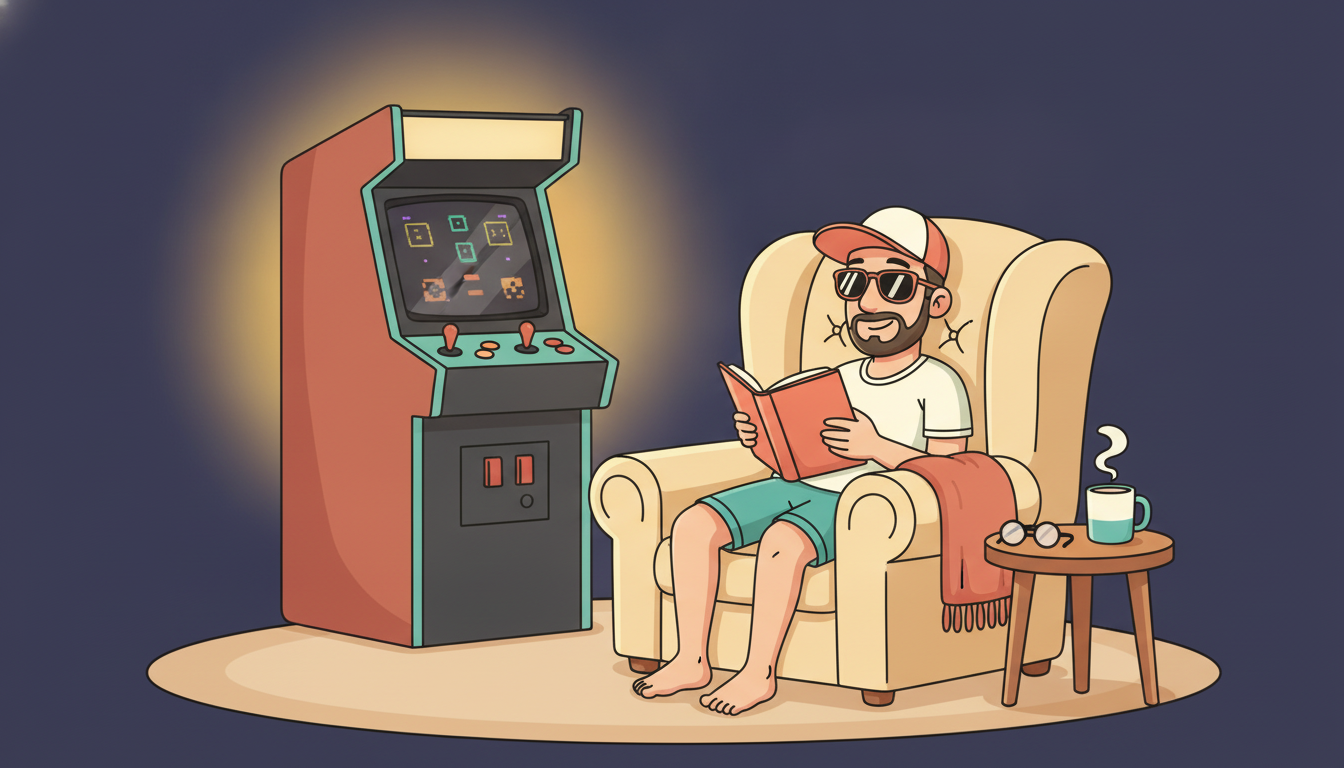
A guy on my last job site swears the Ready Player One movie was “pretty good, actually.” He’s not wrong. He also hasn’t read the book. That’s the whole conversation right there.
So let me back up, because I’m not going to assume you’ve read or watched a thing.
Ready Player One is set in 2045, and the real world has fallen apart — no money, no jobs, folks stacked up in trailer towers. So everybody escapes into the OASIS. Think of it as a video game the size of a planet: you can go to school in there, work in there, hang out, waste your whole life in there. The man who built it, a billionaire named James Halliday, died and left a will with a twist. He hid a prize somewhere inside the OASIS — his entire fortune, and the keys to the whole thing — and whoever finds it wins. The catch? To find it, you have to know Halliday inside out. And Halliday was obsessed with the 1980s. The games, the movies, the music, the dumb TV shows. So the greatest treasure hunt in history turns into a giant ’80s trivia contest. Our hero is Wade — a broke teenager who’s read the man’s diary a hundred times and thinks he’s got a shot.
That’s the setup for both the movie and the book. Here’s where they split.
The movie had to pick and choose. That’s not a knock — that’s just how movies work. Every old game, every song, every character you put on screen has to be paid for and rendered, and there are hundreds of them in this story. So Steven Spielberg (yeah, that Spielberg) grabbed a handful of crowd-pleasers, built some big flashy set pieces that weren’t even in the book — a wild car race, a spooky detour through an old horror movie — and moved on. It looks great. It moves. But it’s the highlight reel.
The book doesn’t have that problem. Words are free.
That’s the thing I keep coming back to. Cline can name-drop a hundred old games and it costs him nothing. He can spend a whole chapter on a guy playing a perfect round of some ancient arcade cabinet, or quoting an entire old movie line for line, because paper doesn’t need a special-effects budget. So the book goes deep where the movie goes wide. It’s denser, nerdier, and a lot more stuffed with little “oh man, I remember that” moments — if you’re the kind of person who remembers that stuff.
Which brings me to the honest part, because that’s what you’re here for.
This book is a blast, but it is not deep. Nobody’s going to mistake it for great literature. The characters are thin, the writing is plain, and about every third paragraph is another reference getting checked off a list. If you want a story that makes you feel something new about being a person, this ain’t it. What it is, is a slick, fast, feel-good treasure hunt with a big warm heart under all the trivia. It’s the reading version of eating a whole bag of chips. You know what it is. You enjoy it anyway.
So who’s it for?
If you grew up feeding quarters into arcade machines, or you’ve ever loved a video game enough to lose a weekend to it, this book was basically built in a lab for you. Same goes if you liked the movie and just want more of that world — the book gives you a lot more. It’s also a great gateway if you don’t read much sci-fi and want something that never gets too heavy or too weird. It explains itself as it goes.
And who’ll roll their eyes? If a wall of pop-culture references feels like homework instead of fun, you’re going to get tired around page fifty. Same if you read for characters and quiet moments — those are not this book’s strong suit. My honest read: some folks are going to find it thin. That’s a fair complaint. I just didn’t care, because I was having too good a time.
For me, it earns its spot in the beach bag for one plain reason. It’s a page-turner you can put down. I can read a chapter, get up to flip burgers or referee whatever Cole and Luke are fighting about, and drop right back in without losing the thread — no need to remember some tangled plot from forty pages back. That’s exactly the kind of book the water is for. Low stakes, high fun, easy to pick up and set down.
One little tip if you’ve only seen the film: don’t read the book expecting the movie’s big scenes, and don’t watch the movie expecting the book’s. They tell the same story two pretty different ways. Read the book for the deep nerdy dive, watch the movie for the popcorn. Do both and you get the full picture — the wide version and the deep one.
I’ll leave you with the line I gave my job-site buddy, right before I handed him my copy: the movie showed you the door. The book actually lets you walk through it.