What Actually Wrecks a Book at the Beach (and the Cheap Kit That Stops It)
September 11, 2026
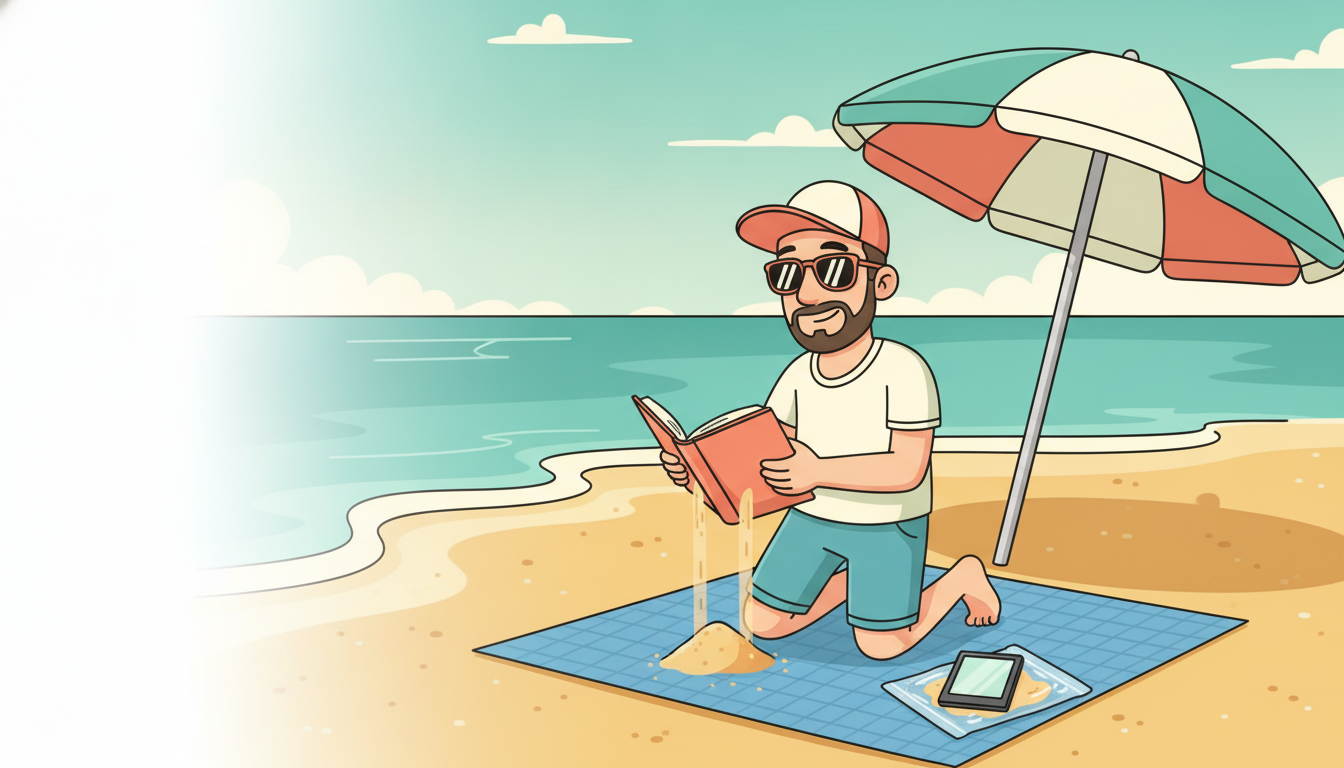
I’ve never lost a book to a wave. I’ve lost two to sunscreen.
That’s the part nobody warns you about. You go to the beach braced for the dramatic stuff — the rogue splash, the tipped drink, the kid doing a cannonball two feet from your lounger — and meanwhile the actual damage is happening quietly, on your own hands, at a rate of about one greasy thumbprint per page.
Four things go after your book by the water. Only one of them is the one you’re watching for.
Salt is the one that costs real money
Here’s a number that stopped me cold.
The waterproof Kindles — the Paperwhite and its cousins — are rated IPX8. Amazon’s own guide spells out what that covers: up to two metres of fresh water, for a full hour. Drop it in a pool, fish it out, keep reading. That’s a genuinely tough little machine.
Then, further down the same page, the seawater number. A quarter of a metre. Three minutes.
Three.
That’s not a typo, and it isn’t Amazon being cagey. Salt water is a different animal from pool water. It’s conductive, it creeps into the seams, and when it dries it leaves crystals behind in places you cannot reach — packed around the charging port and worked in under the bezel. The water evaporates. The salt stays, and it quietly chews on metal for the rest of the device’s life. Your reader can survive the dunk and still die two months later back home in Regina, and you’ll never connect the two.
So the rule I follow is the one out of Amazon’s own care instructions, and it costs nothing: if it touches salt water or pool water, rinse it with fresh water before you dry it. Tap water. A bottle of drinking water. Gently, over the sink. Then wipe it down, stand it on end so the port drains, and leave it alone until it’s properly dry — don’t plug it in, and whatever you do, don’t get clever with a hairdryer. Heat is the other thing on this list, and you’re about to see why it’s a bad idea.
A paperback, for what it’s worth, dies instantly and honestly in salt water. Pages fuse, the cover curls, you throw it out. At least it doesn’t drag the funeral out for two months.
Heat is the one that ends your afternoon
A Kindle is rated to run between freezing and 35°C. That’s 95°F. Above that it gets unhappy, and a modern one will tell you so — a temperature warning comes up and page turns stop working until it cools off.
Now think about what a black rectangle does lying face-up on a white towel in the noon sun. The air might be a pleasant 27. The device won’t be. Dark plastic in direct sunlight climbs past that ceiling in well under half an hour, and the first you’ll know about it is the warning screen, right at the good part.
Paper doesn’t quit on you, but it doesn’t love the sun either. Heat softens the glue in a perfect-bound spine, so the book you left splayed open on a hot deck comes home with a permanent crease and a couple of loose pages. UV yellows the paper. Neither is fast, and both are forever.
The fix is the same for both and it isn’t a product: keep the thing in the shade when you’re not actually holding it. Under the chair, in the bag, face-down on your leg, tucked behind the cooler — anywhere but face-up on a white towel. Shade is free — an umbrella just makes it portable.
Sand doesn’t scratch the cover. It gets in the spine
Everyone worries about sand on the outside. The outside is fine. Sand brushes off a cover the same way it brushes off your arm.
The spine is where it wins. Sand works down into the gutter between the pages, and once it’s in there it’s an abrasive sitting exactly where the paper flexes every time you turn a page. Two hundred turns later the gutter has been sanded rough and the glue has grit worked into it. The book doesn’t break that day. It just gets a little looser every trip until one afternoon a chunk of it comes away in your hand.
On an e-reader the story’s shorter: sand plus a glass screen equals fine scratches, and sand in the USB port is how a charging cable stops seating properly.
Shaking the book out helps, and it’s satisfying — there’s a small pile of Mexico in my nightstand drawer that used to be inside a Michael Connelly novel. But the actual fix is upstream. Stop putting your stuff down on sand. A towel doesn’t do this, by the way. A towel is a sand delivery system with a nice pattern on it; it collects grit in the pile and then hands it straight to whatever you set down.
A mesh mat genuinely solves it. The good ones use two layers of weave offset from each other, so sand shaken onto the top falls through the gaps and then can’t find its way back up through the misaligned layer underneath. Whatever goes down, stays down. It’s the one piece of beach gear I’ve ever owned that does exactly what the box says.
Sunscreen is the assassin
And here’s my nemesis.
Sunscreen is oil. Oil and paper have a permanent relationship — it wicks into the fibres at the page edge, spreads a little further every day, and turns the block of pages a translucent, greasy grey that no amount of care gets back out. It doesn’t wash off. It doesn’t fade. Two hundred pages in, the corner you’ve been holding looks like it was dipped in gravy.
On a screen it’s less permanent but more annoying: an oily film on matte e-ink is surprisingly stubborn, and a dry shirt corner just moves it around in circles.
There is no gadget for this one. There’s a habit. Do your sunscreen first, then wait a couple of minutes and wipe your hands properly on a dry corner of towel before you pick the book up. I keep a cheap microfibre cloth in the beach bag for exactly this and nothing else. That’s the whole trick. It has saved me more books than the pouch has.
So what do you actually buy?
Short version, in the order I’d spend the money.
The pouch, if you bring a device. It’s the cheapest insurance on this list and it covers salt, sand, splash and greasy hands in one go. Buy the tablet-size one, not the phone-size one, and test the seal with a paper towel at home before you trust it with anything.
The mat, if you’re a beach person. This is the real money and the real upgrade. If you go to the beach twice a year, skip it and use a towel like everyone else. If you go every day for two weeks each winter the way I do, it’s the thing you’ll be quietly smug about.
The umbrella, if there’s no shade where you’re going. Get one with a screw-in sand anchor and a tilt joint. A pointed pole jammed into dry sand is a projectile waiting for a gust, and I’ve watched one take out a family’s lunch.
The page holder, because it’s nearly free and it’s great. Least important, most fun. One hand on the book, one hand on the drink, wind can’t flip you forward.
And the skips, since a gear post that recommends everything is just a catalogue. You don’t need a waterproof book — they exist, they’re for the pool, and the selection is roughly forty titles you’ve never heard of. You don’t need a giant dry bag; it’s heavy, it’s overkill, and you’ll leave it in the closet. And you really don’t need a padded “book jacket,” which protects the one part of a book that was never in danger.
The honest ruling
Most of what wrecks a book at the beach isn’t water, and almost none of it is dramatic.
It’s salt you didn’t rinse off. It’s heat from a device left face-up in the sun. It’s grit that got into the spine because you set the book down on a towel. And it’s the oil on your own hands, which is the one that gets me every single year, because I know the fix, and I still reach for the book before I’ve wiped my thumbs.
Buy the pouch. Steal the shade. Wipe your hands.
My wife Dee says I should just get a waterproof book and be done with it. Dee has not read the waterproof books.